Building
by
Yongjae Lee
Jacob Chanyeol Choi

Our new paper shows how to turn a fund's public record into a persona an AI can follow, making its advice more consistent and relevant.
Imagine you are an investor who prefers stocks that pay a steady dividend. Lately, high-flying technology stocks are all over the news, and you wonder if you should sell some of your holdings and switch. You ask an AI financial advisor for its opinion.
There is no single right answer to your question. An advisor focused on momentum might say to rotate into tech, while one focused on income would likely advise you to stick with your reliable dividend payers. The problem is that a generic AI, even one told to be an "experienced advisor," has no specific, stable point of view.
Without a guiding philosophy, its advice can feel bland or inconsistent. To be helpful, an AI needs a clear investment style, just like a human expert.
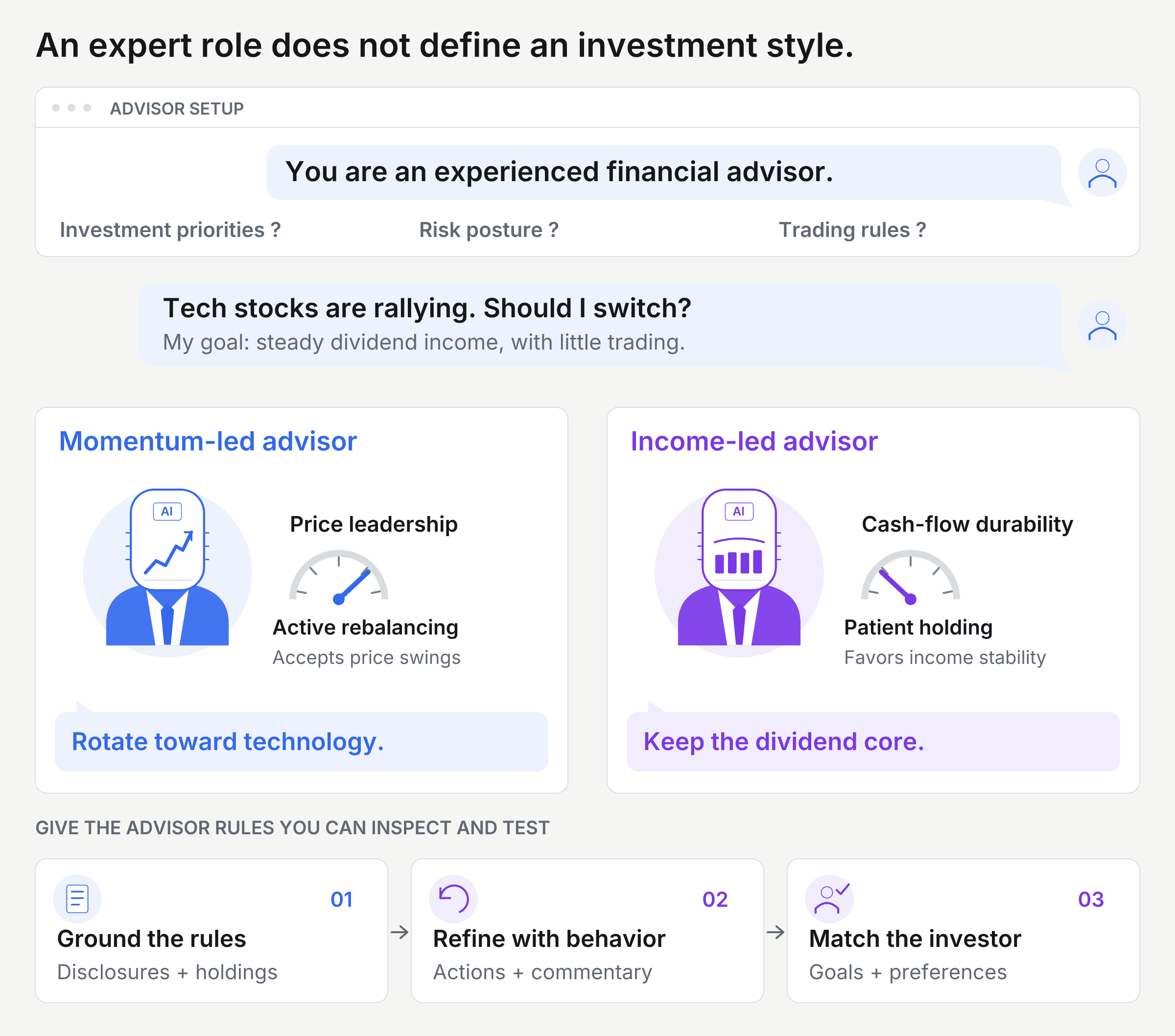
Same question, two answers. What an advisor recommends depends on the investment philosophy it is given. These two replies are illustrations, not real model output.
Funds Already Show How They Invest
So how do you give an AI a specific investment philosophy? We found we did not have to invent one. Professional fund managers already publish detailed information about how they think and invest.
A fund's prospectus states its goals and strategy. Its quarterly reports show which stocks it actually bought and sold. And its shareholder letters explain the manager's reasoning in their own words.
Our new paper, Fund2Persona, shows how to turn this public information into a persona, a written rulebook that tells the AI how a specific manager thinks. We build a first draft of the persona from the fund's prospectus and its starting portfolio. Then, we automatically check this persona against the fund's actual behavior and rewrite the rules where they were wrong.
The AI Acts More Like the Real Manager
Our first test was to see if an AI using our personas could learn to behave like a specific fund manager. We tested this on 69 active U.S. stock funds, asking different AIs to replay their decisions from the third quarter of 2025 to the first quarter of 2026. Each AI started with the fund's real portfolio and saw the same market news.
The task was to say whether the real manager had increased, held, or decreased their position in each top stock, after we filtered out changes caused only by price movements. We scored the AIs using a measure called macro-F1, which gives equal credit for correctly calling buys, holds, and sells.
The AI with our improved persona, Fund2Persona, scored 0.410, which was 23% higher than a generic AI given only an "experienced advisor" prompt (0.334). A persona from just the fund’s prospectus and holdings (0.362) also beat the generic AI, but our process of correcting the persona made the biggest difference.

Closer to the manager's real moves. The improved persona from the correct fund helped the AI match the manager's behavior most closely.
One result was surprising. An improved persona from a different, randomly chosen fund still beat the generic AI (scoring 0.364). This suggests active managers share some habits, but learning the style of the correct manager is what matters most.
The persona also helps the AI sound like the manager. Asked to write market commentary for 40 funds, Fund2Persona's text was picked as closest to the real manager's letter 30% of the time, compared with 17.5% for the generic AI.
Better Personas Lead to More Helpful Advice
What does this mean for our dividend investor wondering about tech stocks? It means they could get advice from an AI that shares their income-focused philosophy. To test this, we created 50 realistic investor profiles from FAR-Trans, a dataset based on real, anonymized customer data.
We matched each investor to an AI advisor using the persona of a fund whose style fit them. We then simulated a five-turn conversation and had a separate AI judge compare the responses from different advisors, without knowing which was which. The judge made a choice at the third and fifth turns.
By the fifth turn, the judge preferred Fund2Persona over the generic advisor in 69% of comparisons, or in roughly 7 out of 10 cases. This gap widened from the third turn, where the preference was only 51%. Our full method also won against an AI using a deliberately mismatched style (87%), the prospectus-only persona (65%), and the persona before our improvements (70%).
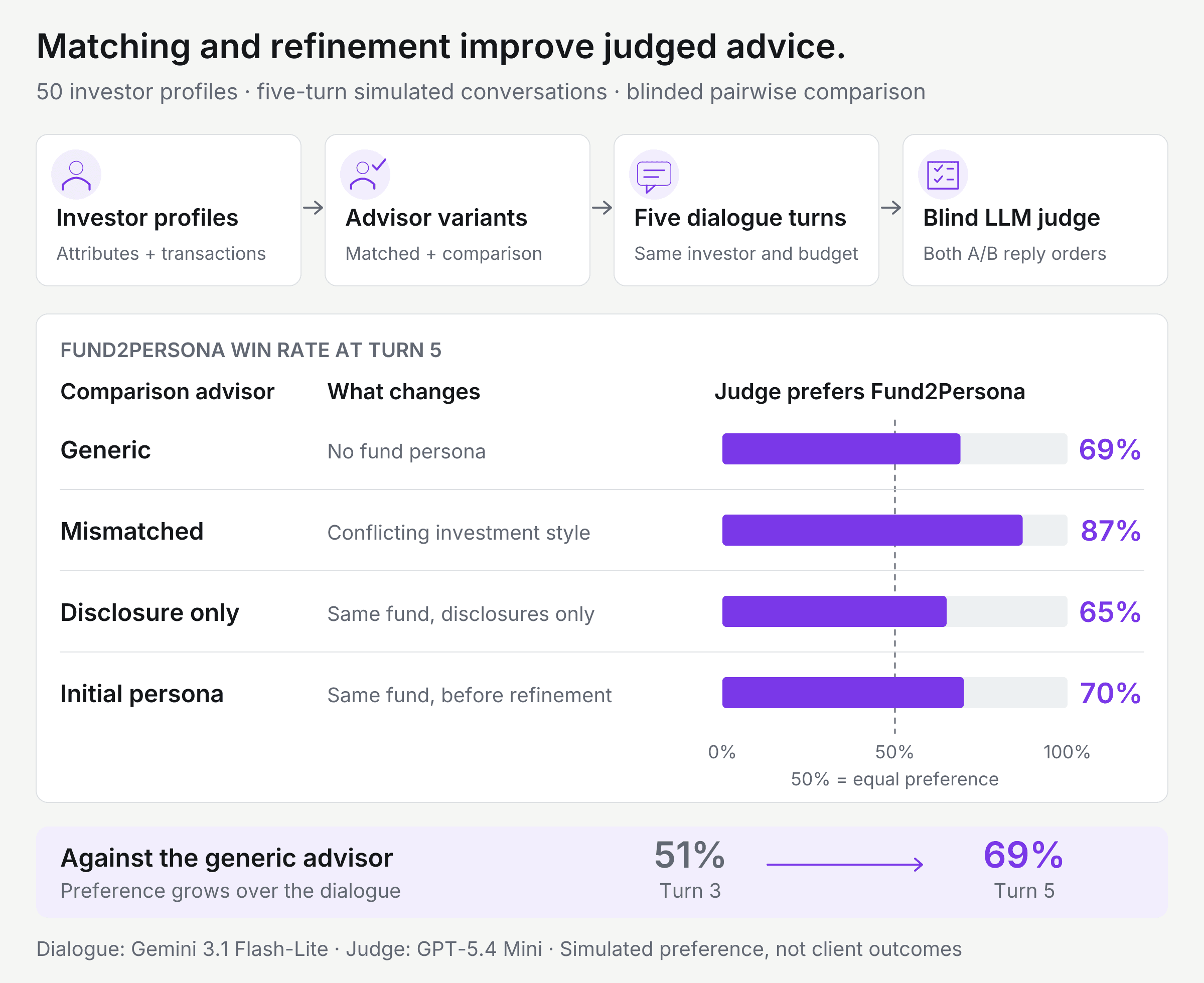
An AI judge preferred the matched, improved advisor. Win rates at the fifth turn of conversation show a clear preference for Fund2Persona over four alternatives.
An AI judge is only useful if humans agree with it. We ran a small pilot study with 15 people, including 5 finance professionals and 10 people with prior investing experience. They agreed with the AI judge's choice of the best advice 78.7% of the time, much higher than the 50% expected by chance.

Humans largely agreed with the AI judge. In a small 15-person pilot, people picked the same answers as the AI judge well above chance.
Using Real Manager Styles Creates a Diversity of Opinions
If you ask the same large language model a question multiple times, you often get very similar answers. We wanted to see if using personas from different managers could create a healthier variety of perspectives. We took 95 economic and business questions.
First, we asked a generic AI the same question 20 times. Then, we asked the same question to 20 different AIs, each using a unique persona from the most relevant funds in our library. We measured how much the answers differed from each other in meaning.
The answers from the 20 different fund personas were more varied (a score of 0.381) than the 20 answers from the single generic AI (0.313). For over 91% of the questions, the group of specialized AIs produced a wider range of views. This is about generating a richer set of perspectives, not just finding one right answer.

More personas, more perspectives. Using 20 different fund personas generated a wider variety of answers than asking one generic AI 20 times.
How the Persona Gets Better: A Look Under the Hood
For curious readers, here is how our system works. The process starts with an "actor" AI that uses the current persona to make trading decisions for past quarters. A "scorer" AI compares the actor's trades to what the fund actually did. A "patcher" AI then analyzes the mistakes and rewrites the faulty parts of the persona, using the manager's own written commentary from that period.
We run this improvement loop twice, creating two revised versions. A final validation step tests all three versions on a separate time period and picks the one that best matches the manager.
To make sure no future information leaked in, we kept the time periods separate. The persona was corrected on portfolio changes from Q1 2024 to Q1 2025, the best version was picked on Q1 to Q3 2025, and the final test used Q3 2025 to Q1 2026, a period the AI had not seen. Manager commentary was used only if it was both written and filed before the picking period.
Building and picking one fund's persona takes 17 model calls and costs about 8 cents on average. That covers the persona only, not data preparation or ongoing use.
We used GPT-5.4 Mini to build and rewrite the personas and to act as the judge. For making decisions and writing advice, we used Gemini 3.1 Flash-Lite.

The Fund2Persona improvement loop. We use a fund's real-world behavior to automatically check and rewrite its AI persona.
What This Does and Does Not Show
This research is a step toward building more specific AI advisors, but it has limits. We showed that an AI can act more like a particular manager. This is not the same as proving it can make money, as matching an investment process is different from forecasting market returns.
Our study focused on 69 active U.S. equity funds, so the framework might work differently for other assets or countries. We also tested advice quality in simulated chats, evaluated mainly by an AI judge with a small human pilot for verification. Real-world client interactions might lead to different outcomes.
What This Means for Building AI Advisors
For those creating AI tools in finance, our work suggests a practical way to define an advisor's investment philosophy. Ask specific questions about the desired strategy, such as:
What evidence should raise the advisor's conviction?
What should make it cut a position?
When should it stick with its mandate through a stretch of underperformance?
Write the answers as rules you can test, check them against real decisions, then test again on a later period the advisor has not seen.
Paper
Fund2Persona: A Framework for Building and Refining Financial Advisor Personas from Fund Disclosure Data
Authors | Suhwan Park¹,*, Hoyoung Lee¹,²,*, Zhangyang Wang³, Alejandro Lopez-Lira⁴, Young Cha⁵, Chanyeol Choi², Jaewon Choi⁶,†, and Yongjae Lee¹,²,† |
|---|---|
Affiliations | ¹ UNIST / ² LinqAlpha / ³ University of Texas at Austin / ⁴ University of Florida / ⁵ Blackstone / ⁶ Hanwha Life. * Equal contribution. † Corresponding authors. |
Venue | 2026 Conference on Empirical Methods in Natural Language Processing (EMNLP 2026), Industry Track |
Presented | October 24 to 29, 2026, Budapest, Hungary |