
“The real value of LinqAlpha goes beyond finding information faster. It enables us to interpret market changes through the lens of our portfolio, our accumulated investment experience, and Hanwha Insurance’s own decision-making framework. By connecting external information with the context and knowledge we have built internally, we can make investment decisions with greater depth, consistency, and conviction.”
Don Oh, CIO, Hanwha Insurance
About Hanwha Insurance
Established in 1946, Hanwha Insurance was South Korea’s first insurance company founded entirely with domestic capital and has played a longstanding role in the development of the country’s general insurance industry.
Today, the company offers a broad portfolio spanning long-term, automobile, and general insurance. Supporting that business is a multi-asset investment organization responsible for managing capital across diverse markets and asset classes.
Key Highlights
~160,000 internal documents spanning at least eight years, connected through an investment-specific knowledge structure
10 production agents across five connected workflows, supporting CIO briefing, credit, alternatives, contract review, and due diligence
One intelligence layer across multiple asset classes, connecting external market developments with portfolio and institutional context
OPPORTUNITY
Multi-asset investing requires teams to connect very different kinds of information. A credit professional may be tracking disclosures, ratings actions, refinancing risk, and changing financials, while an alternative investment professional may be tracing an underlying asset through manager reports, reviewing fund documentation, or comparing a new opportunity with earlier investments.
At Hanwha Insurance, that work also draws on years of accumulated investment experience. The challenge was not simply finding more information, but connecting external developments with the portfolio, historical investment context, and the frameworks Hanwha uses to evaluate investments.
Hanwha therefore set out to apply AI to recurring investment work—not as a general-purpose chatbot alongside the investment process, but as a way to make institutional knowledge and investment frameworks usable within it.
SOLUTION
One connected workflow across the allocator lifecycle
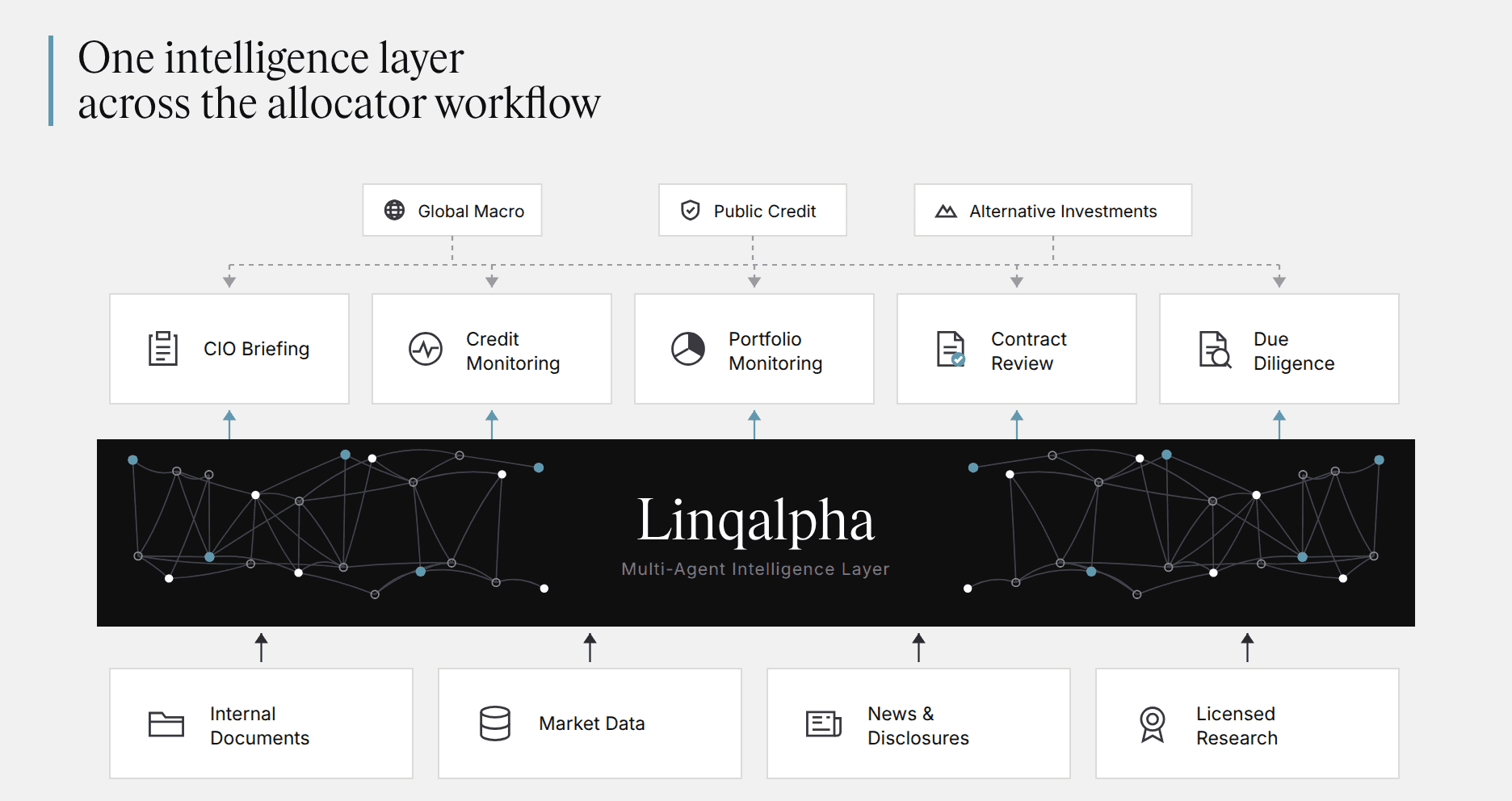
Hanwha Insurance and LinqAlpha translated the allocator lifecycle into five connected workflow families:
CIO briefing: connecting global macro and market developments with potential portfolio implications
Credit monitoring: tracking material developments across domestic and international bond portfolios from a bondholder’s perspective
Alternative investment monitoring: looking through funds to managers, deals, underlying assets, and issue-level developments
Contract review: surfacing key provisions and potential risks in fund documentation against internal review standards
Due diligence: organizing source materials, important questions, comparable cases, and key risks into a structured first draft
Each workflow is more than a single AI agent. Behind the user experience, LinqAlpha’s orchestration layer coordinates specialized agents for retrieval, classification, comparison, analysis, citation, and validation - allowing complex investment tasks to be broken down, executed in parallel, and reconciled into a single output.
Contract review, for example, uses six coordinated agents to examine documents from different perspectives, compare provisions, surface potential issues, and quality-check the output. For periodic portfolio reviews, dedicated agents can work across individual invested funds simultaneously, with coverage checks before findings are consolidated.
Each workflow combines the sources appropriate to the task - including public information, licensed research, and institution-specific documents - while preserving the analytical perspective and output required by the investment team.
Making institutional knowledge usable by AI
Access to information is not the same as understanding its investment context.
Across alternative investments alone, approximately 160,000 historical reports and investment documents represented years of accumulated institutional knowledge. LinqAlpha built an investment-specific knowledge structure connecting those materials to relevant funds, managers, asset classes, reporting periods, deals, underlying assets, and other entities.
Combined with purpose-built search and retrieval infrastructure, this structure allows agents to identify evidence in the context of the investment itself rather than treating the archive as an undifferentiated collection of files.
Users can search across years of historical materials and carry the resulting context into due diligence, contract review, monitoring, or portfolio assessment. Findings remain connected to their supporting sources, while incomplete or uncertain cases can be surfaced for professional review.
From Document Review to Investment Judgment
The practical change is clearest in workflows that previously required extensive manual document review.
For contract review, the system surfaces the provisions investment professionals expect to see:
“It reliably identifies the key LPA terms and helps surface important clauses that may be overlooked during the initial review.” - Hanwha Insurance investment professional
For due diligence, the value was similarly practical:
“It gives us a strong first draft, clearly identifying and summarizing the points that matter most.”- Hanwha Insurance investment professional
These workflows do not replace professional review. They give investment professionals a stronger starting point - surfacing the evidence, terms, developments, and risks that warrant attention so the team can spend more time on the assumptions and decisions that require judgment.
IMPACT
From Individual Expertise to Institutional Capability
The most important shift is not simply faster retrieval. Hanwha Insurance is seeing how the investment methods developed by its professionals can become reusable institutional capabilities.
Experienced investors develop established ways of reviewing managers, assessing credits, interpreting portfolio events, and preparing investment discussions. Encoding those methods into agentic workflows creates an opportunity to apply them more consistently, refine them through continued use, and make accumulated investment knowledge more accessible across the institution.
“I am thinking about expanding this into a workflow of my own on LinqAlpha. I have come to realize that there may be far more ways for us to use it than I initially expected.”
Don Oh, CIO, Hanwha Insurance
LOOKING AHEAD
Building on Institutional Knowledge
The initial three-month collaboration established a working foundation across multiple asset classes and investment processes. The next phase is about deepening existing workflows, developing new ones, and connecting more of Hanwha Insurance’s accumulated investment knowledge over time.
For Hanwha Insurance, the result is more than a collection of AI tools. It is a growing institutional intelligence layer - one that connects market information with portfolio context, accumulated experience, and the investment judgment built over decades.