
LinqAlpha and J.P. Morgan co-host the AI for Finance Summit Boston, sponsored by AQR Capital Management and Foley Hoag.
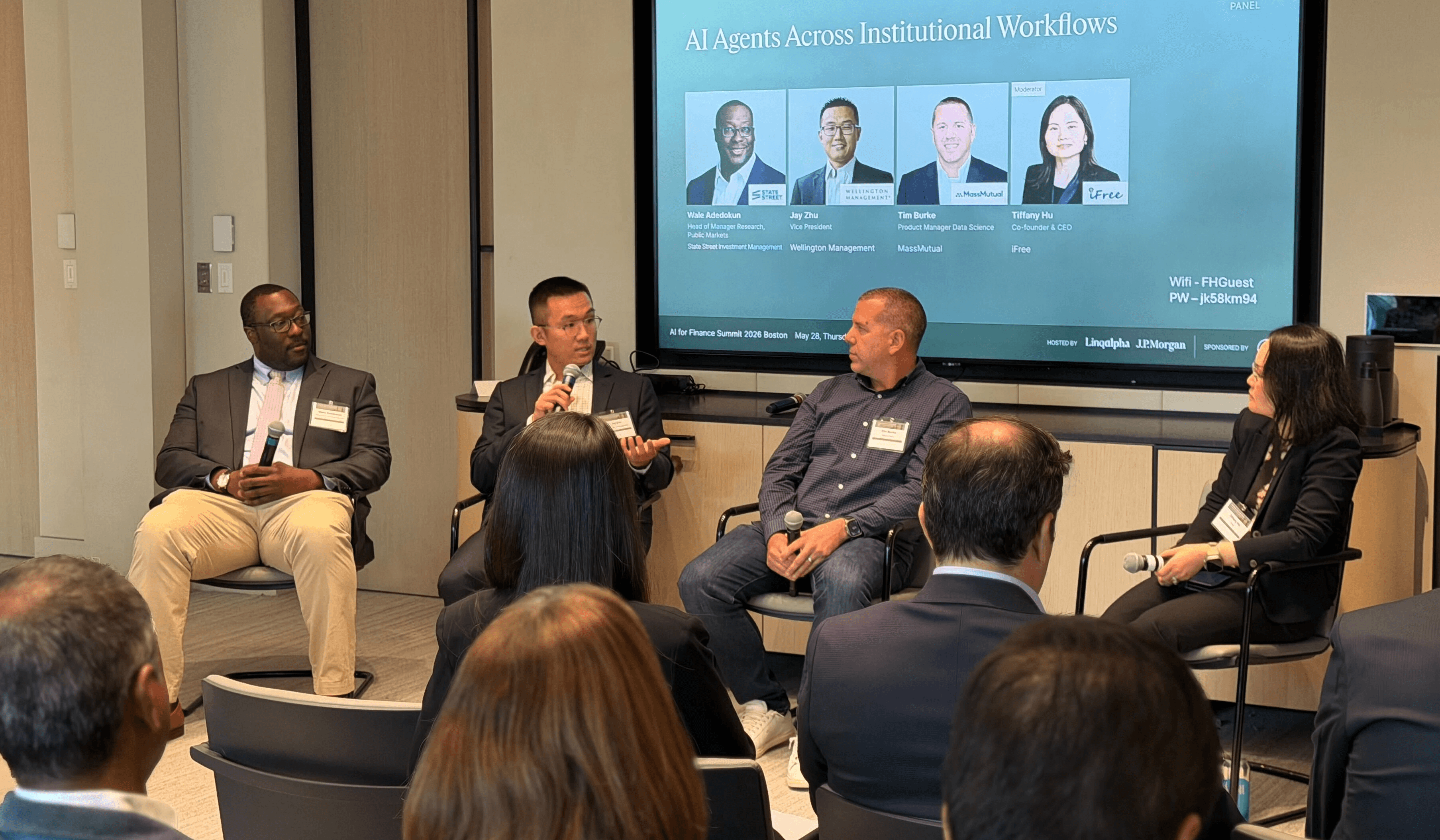
We co-hosted the AI for Finance Summit Boston with J.P. Morgan on May 28, sponsored by AQR Capital Management and Foley Hoag. About 100 practitioners in the room, 65% buy-side, 16 speakers across two firesides and three panels, all under Chatham House Rule.
What stood out across the day is that the same tensions kept surfacing, regardless of whether the conversation was about research, operations, or autonomous agent architecture. Six threads ran through every session.
The first is that as models keep getting better, the surface area of failure grows with them. Better capability does not reduce production risk, it just changes the shape of it. The harder problem moved from “can it answer” to “can we trust the path it took to the answer.”
The second is the way the vocabulary keeps shifting. Prompt engineering was the 2023 conversation. Context engineering took over in 2024. What people are actually building in production now is harness engineering, the layer of tools, validators, hard gates, soft gates, and audit trails that sit around the model.
Third, you do not need perfect data to start, but you need traceable data. The point that landed in the room was that AI is not creating data gaps, it is surfacing the gaps that were always there. Trust and accessibility now sit next to cleanliness as core requirements.
Fourth, top-down mandates do not work. Bottom-up adoption does, with guardrails. The centralized AI program offices that are working are the ones that unlock platforms and governance, then let practitioners with the right tools build prototypes next to engineers in a safe environment.
Fifth, speed is a governance design issue, not a governance bypass. The firms shipping fastest are not skipping compliance, they are bringing it in from day one and designing systems where the deterministic surface area is large and the non-deterministic surface area is contained.
Sixth, accountability cannot be delegated to the agent. The same line landed across every panel. If a human would not be allowed to take an action autonomously, an agent should not either. The throat-to-choke question stays human.
New York picks up today, June 2, with deeper focus on alternative data and prediction markets. London, Singapore, and Hong Kong are next.
Learn more at linqalpha.com or contact support@linqalpha.com.